

Share


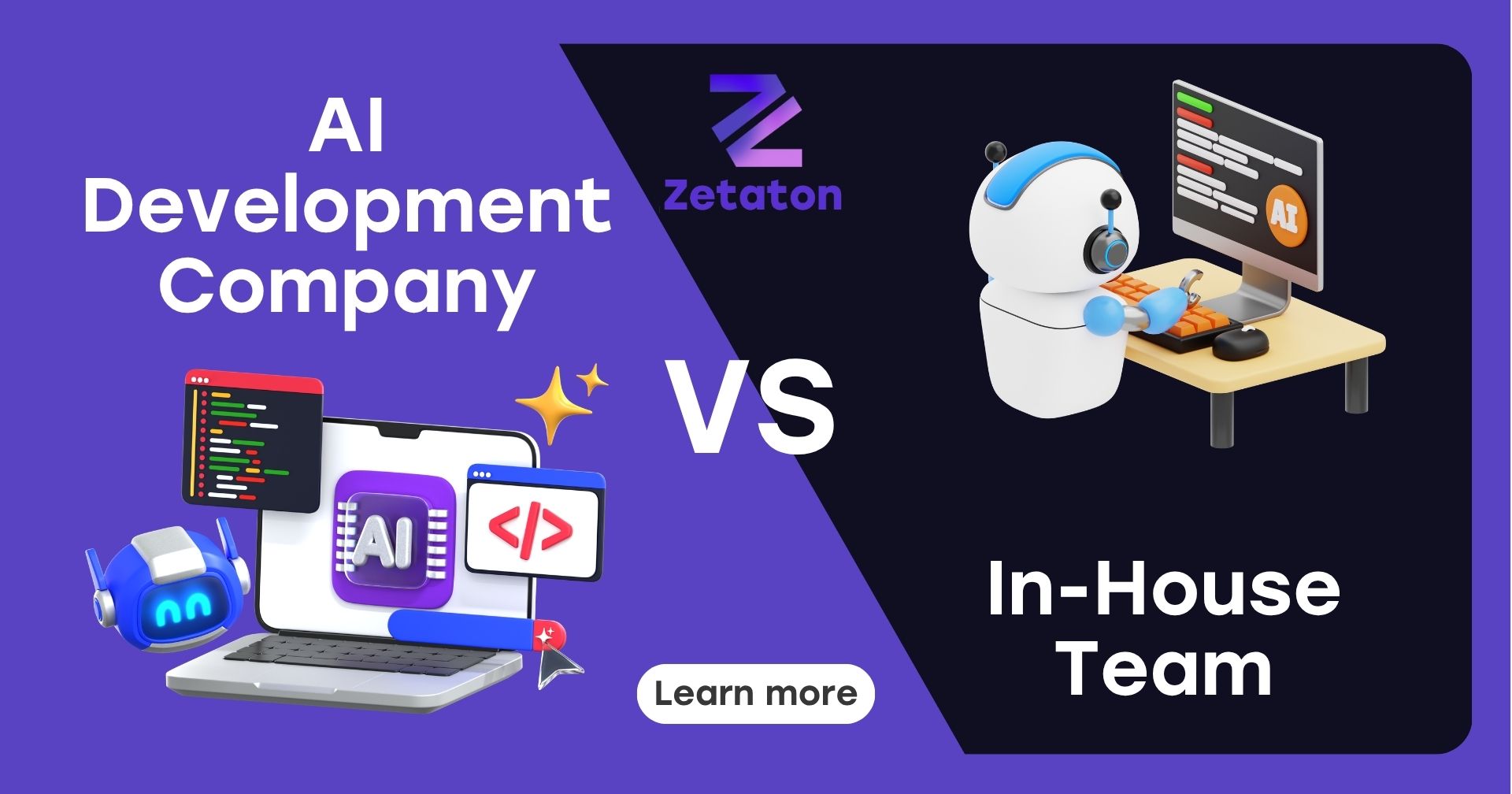
You've secured leadership buy-in and allocated budget for your first significant AI initiative. The use case is defined. Now comes the decision that will determine whether your project ships in 12 weeks or 18 months — and whether you actually own what gets built: do you hire an AI development company or build an in-house team?
This isn't a simple build-vs-buy question. It's a strategic choice that shapes your time-to-market, total cost of ownership, intellectual property rights, and your organization's capacity to iterate on AI systems for years ahead. Get it wrong and you'll either burn six months recruiting engineers who cost $200,000+ annually — or hand sensitive business data to a vendor whose contract gives them more rights to your model than you assumed.
This guide delivers a precise cost comparison, a multi-dimensional risk breakdown, and a decision framework that covers the full landscape — including the hybrid model most organizations overlook entirely.
An AI development company delivers faster time-to-market at lower upfront cost, making it the stronger choice for scoped projects and first-time AI deployments. An in-house team provides IP ownership, data control, and long-term cost efficiency — but demands 12–18 months of sustained investment before reaching full operational productivity.
Cost is the most common driver behind this decision — and the most frequently miscalculated. Decision-makers typically compare vendor hourly rates against engineering salaries and stop there. The accurate comparison requires examining total cost of ownership across a 12–24 month window, accounting for recruitment lead times, ramp periods, infrastructure spend, and operational overhead.
A functional in-house team capable of building, deploying, and maintaining production-grade AI models requires a minimum of four to five specialized roles. At U.S. market rates, expect:
That's $730,000–$970,000 in salaries alone — before cloud infrastructure costs on platforms like AWS SageMaker or Databricks, tooling licenses, and recruiter fees averaging $20,000–$50,000 per hire. Layer in a 6–9 month ramp period before the team reaches full productivity, and Year 1 total investment typically lands between $1.2 million and $1.6 million.
An AI development company charges $80–$250 per hour depending on geography and domain specialization. A scoped project — building a custom NLP classification system or a demand forecasting pipeline — typically costs $60,000–$250,000. Ongoing support retainers average $15,000–$40,000 per month.
The structural advantage: zero recruitment cost, zero ramp period, and no benefits overhead. Specialized vendors arrive with pre-built deployment playbooks and infrastructure refined across dozens of prior engagements. Firms like Accenture's AI practice or specialized AI boutiques routinely compress what would take eight months in-house to 10–14 weeks for equivalent scope.
The inflection point matters: for organizations with continuous, evolving AI needs, vendor retainer costs compound. By month 24–36, total outsourced spend frequently exceeds what an equivalently capable in-house team would have cost from that point forward.
This table surfaces the core trade-off: an AI development company wins decisively on speed and Year 1 cost. An in-house team wins on long-term cost efficiency and control — but only after the 18–24 month mark.
Speed is where the gap between these two models becomes most pronounced — and where organizations most consistently underestimate what it takes to build internally.
AI development roles require highly specialized skills that don't transfer from general software engineering. Model fine-tuning, vector database integration, LLM orchestration, and production MLOps all demand compound expertise that takes years to develop. The talent scarcity is structural: McKinsey's 2024 Global AI Survey confirms that 72% of organizations identify AI talent as their top execution barrier — ahead of budget and technology access.
Even after hiring, onboarding is non-trivial. New AI engineers must absorb your data architecture, governance standards, business context, and internal tooling before contributing to production. In regulated industries — healthcare, financial services, insurance — this ramp commonly extends to 9–12 months before a single production model ships.
An experienced AI development company arrives with battle-tested infrastructure already in place: MLOps pipelines, model evaluation frameworks, deployment automation, and retraining protocols refined across multiple prior client engagements. Vendors who work regularly with Hugging Face's model hub, for instance, can fine-tune pre-trained language models — BERT, Mistral, Llama — on your proprietary data in days rather than months. That same process takes significantly longer for an in-house team encountering these tools for the first time.
Speed compounds in problem-solving too. Experienced vendors have already encountered and resolved model drift, data leakage, training pipeline failures, and inference latency issues. They don't learn those lessons on your timeline or your budget.
Speed favors external vendors — flexibility favors internal teams. When your AI product evolves continuously, you need engineers who can respond to a product decision at 9 a.m. and ship a model update before end of day. No vendor retainer, however well-structured, replicates that iteration cycle.
Companies that treat AI as a core competitive differentiator — rather than a supporting function — build and retain in-house teams for precisely this reason. If your AI use case sits at the center of your product or business model and requires daily iteration, in-house is the correct long-term architecture. If you need a defined AI deliverable shipped within a constrained window, an external partner is the more pragmatic choice.
Risk is the dimension most decision-makers underweight — until something goes wrong. AI development introduces multi-dimensional organizational risk: data security, model ownership, vendor dependency, and regulatory exposure each create distinct categories of exposure that demand specific attention before you sign anything.
Contract language determines IP ownership entirely — and many organizations execute vendor agreements without scrutinizing this clause. Standard work-for-hire contracts assign trained model weights, deployment code, and fine-tuning pipelines to the client. That's the default position, but it's not universally applied.
AI development companies frequently retain rights to underlying proprietary methodologies, base model architectures, and internal training frameworks they developed prior to your engagement. Before signing, verify explicit client ownership of: trained model weights, custom fine-tuning procedures, inference and serving code, and all training data pipelines. Negotiate these terms before project kickoff, not after delivery.
Training AI on proprietary business data creates third-party data handling risk when you engage an external vendor. Customer records, transaction histories, health data, and operational telemetry — all potentially required to build a high-performance model — now travel outside your infrastructure. For organizations operating under GDPR, HIPAA, or SOC 2 Type II obligations, this requires data processing agreements (DPAs), data residency verification, and sub-processor audit trails before the engagement begins.
An in-house team eliminates this risk category. Your training data, model weights, and inference logs remain within your own infrastructure under your own access controls — a non-negotiable requirement for certain industries and regulatory environments.
Concentration risk in AI is real and underappreciated. If a single AI development company owns your production AI system and that vendor raises rates, loses key personnel, or deprioritizes your account, your AI roadmap stalls with no obvious recovery path. Mitigate this by negotiating documentation standards, source code handover rights, and mandatory knowledge transfer obligations into any engagement contract. A vendor who resists explicit IP or data clause negotiation is a red flag — not a negotiating starting position.
Neither model is universally superior. The right choice depends on your organization's AI maturity, budget horizon, data sensitivity requirements, and strategic intent for AI across your product or business model.
Choose an external AI development partner when:
Organizations in regulated industries also benefit from vendors who arrive with pre-built compliance frameworks — eliminating 3–4 months of internal certification work on a first deployment.
Build internal AI capability when:
The most effective path for mid-market organizations is a phased hybrid engagement: hire an AI development company to build and deploy Version 1, negotiate a structured knowledge transfer clause, then hire 2–3 in-house ML engineers to own and iterate the system post-handover.
This model captures vendor speed in the critical early phase, transfers institutional knowledge before lock-in becomes a risk, and builds internal capability on a working foundation rather than from zero. Databricks' professional services organization operates under a comparable model — building client data and ML infrastructure, then transferring full operational ownership to the client's engineering teams after go-live. The result: faster deployment timelines and long-term internal autonomy, without forcing a binary choice between the two.
Vendors in low-cost geographies quote $30–$50/hour rates that compound through scope creep, communication overhead, and rework cycles. Evaluate total engagement cost against defined milestones — request a fixed-scope proposal and weight production references over rate cards.
Most internal project plans assume 3 months to team productivity. The realistic figure is 6–9 months. Build project schedules around the actual ramp curve to avoid missed commitments downstream.
Never execute an AI development agreement without documented ownership of model weights, training data handling protocols, code handover obligations, and post-engagement data deletion procedures. Negotiate upfront — not after delivery.
AI projects fail at higher rates than standard software builds because model performance depends on data quality, not code correctness alone. Audit your training data and establish quality baselines before engaging any team — internal or external.
Organizations frequently hire data scientists before building the operational infrastructure to support them. Without model versioning, monitoring, and drift detection — available through tools like AWS SageMaker Pipelines or MLflow on Databricks — production models degrade silently. Establish MLOps infrastructure before the first model ships.
Most coverage of this topic forces a two-option decision. A phased hybrid engagement eliminates the core weaknesses of both approaches. Structure your AI roadmap in phases with clear ownership transitions written into the contract from the start.
A mid-sized U.S. retailer needed a demand forecasting model integrated with their ERP before peak season — a hard 4-month window with no flexibility. Rather than hire in-house, they engaged a supply chain AI specialist using Amazon Forecast as the foundational platform. The vendor delivered a fine-tuned production model in 11 weeks. The retailer reduced overstock costs by 23% in the first quarter post-deployment, recovering the vendor engagement cost within a single inventory cycle.
A Series B healthtech company used an external AI vendor to build their initial clinical NLP pipeline. Post-deployment, they hired three ML engineers under a structured knowledge transfer agreement negotiated at contract signing. Within 18 months, the internal team reduced model inference latency by 40% and shipped two additional features the vendor had scoped at an additional $180,000. The in-house transition generated over $300,000 in Year 2 savings relative to continued vendor dependency.
A regional financial institution needed AI-powered fraud detection but could not share transaction data with third parties under regulatory obligations. They engaged an Accenture AI engineering team to architect and deploy the model entirely within their private AWS GovCloud environment, then transferred full system ownership to their internal security engineering function post-go-live. Fraudulent transaction approvals declined 31% within six months of production deployment.
A B2B SaaS company needed a customer sentiment analysis feature to retain a critical enterprise account on renewal. Their engineering team lacked NLP depth. They partnered with an NLP consultancy running fine-tuning pipelines on Hugging Face's model hub. The feature shipped in 8 weeks — contributing directly to a $1.2M contract renewal and validating a broader internal AI roadmap the company activated the following quarter.
The choice between an AI development company and an in-house team is not a permanent structural commitment — it's a strategic decision tied to your current timeline, data constraints, budget horizon, and long-term AI ambitions. External vendors deliver speed and specialized expertise at lower upfront cost; internal teams deliver IP ownership, data control, and compounding capability over time. For most mid-market organizations, the phased hybrid model eliminates the core weaknesses of both approaches and provides the most pragmatic path to a production AI system you actually own. Map your initiative against the decision framework in this article — then move on the model that matches your actual constraints.
An AI development company is cheaper in Year 1, with total project costs ranging from $60,000 to $250,000 versus $1.2–$1.6 million to build a complete in-house team from scratch. However, ongoing retainer costs of $15,000–$40,000 per month mean cumulative outsourced spend typically surpasses in-house costs by month 24–36 for organizations with continuous AI development requirements.
Most scoped projects with experienced AI vendors ship to production in 10–16 weeks, depending on data readiness, integration complexity, and model type. In-house teams typically require 6–12 months before delivering a comparable production-ready model, due to hiring lead times, onboarding, and infrastructure setup — regardless of how strong individual hires are.
Ownership is governed entirely by your contract. A standard work-for-hire agreement assigns trained model weights, deployment code, and fine-tuning pipelines to the client. Always negotiate explicit IP clauses before signing — specifically covering model weights, training data handling, inference logic, and any proprietary frameworks the vendor applies during development. Do not assume default terms protect you.
Primary risks include vendor lock-in, data handling exposure for regulated data sets, IP ownership ambiguity in poorly structured contracts, and failure to build internal AI capability. Mitigate each through explicit contract terms, phased engagement structures with built-in knowledge transfer clauses, mandatory documentation standards, and clear code handover obligations before the vendor relationship ends.
A hybrid model engages an external AI development company to build and deploy the initial AI system, then transfers full ownership to an internal team through a contractually required knowledge transfer process. This captures vendor speed in the critical early phase while building internal capability on a working foundation — avoiding both the cold-start problem of in-house-only builds and the lock-in risk of long-term vendor dependency.
Assess vendors across five dimensions: demonstrated production deployments in your industry vertical, their MLOps methodology and deployment infrastructure, explicit contract terms on IP and data handling, client references with measurable quantitative outcomes, and their documented knowledge transfer process. Prioritize vendors who can provide production references over those who lead with portfolio visuals — and treat resistance to IP clause negotiation as a disqualifying signal.
Solutions
© current_year Copyright, All Rights Reserved
.avif)


